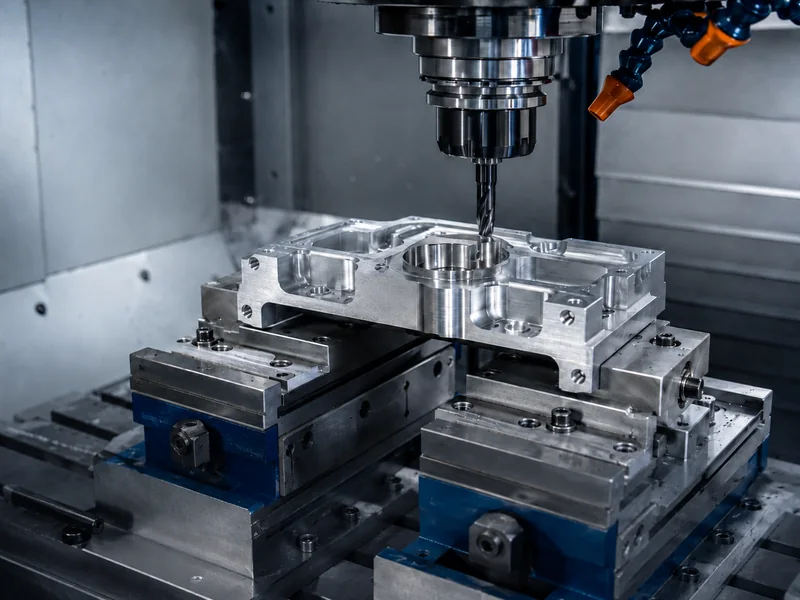
Design for Manufacturability (DFM) is the practice of designing parts so they can be machined accurately, quickly, and at the lowest possible cost. In our experience quoting thousands of CNC machined parts every month, the same handful of design decisions drive the majority of avoidable cost. Below are the ten tips our engineers give customers most often.
1. Only tighten tolerances where they matter
Tight tolerances are the single biggest cost driver in CNC machining. A tolerance of ±0.005mm can require slower feeds, additional setups, temperature-controlled inspection, and higher scrap rates. Apply tight tolerances only to critical features (bearing bores, mating interfaces, sealing surfaces) and leave everything else at a standard tolerance such as ISO 2768-m. See our tolerances guide for what is achievable per process.
2. Add radii to internal corners
End mills are round, so a perfectly square internal corner cannot be milled. Design internal corner radii at least 1/3 of the cavity depth — ideally matching a standard tool radius (e.g. R3 for a 6mm end mill). Sharp internal corners force EDM or hand finishing and increase cost dramatically.
3. Avoid deep, narrow pockets
A cutting tool's reach is limited by its length-to-diameter ratio. Beyond roughly 4:1, tools deflect, chatter, and leave poor surface finishes. If a deep pocket is unavoidable, widen it, step it, or split the part into an assembly.
4. Standardize hole sizes and threads
Drilled holes in standard metric or imperial sizes are cheap; custom diameters require boring or reaming. Keep thread depth to a maximum of 3× diameter — deeper threads add no strength but add tapping risk. Specify standard threads (M3, M4, M5…) wherever possible.
5. Design thin walls with care
Walls thinner than 0.8mm in metal (1.5mm in plastic) tend to vibrate and warp during machining. If weight reduction is the goal, consider ribbing or pocketing rather than uniformly thin walls.
6. Minimize setups
Every time a part is re-fixtured, cost and tolerance stack-up increase. Features that can all be reached from one or two directions machine cheaply on 3-axis equipment; parts with features on many faces may justify 5-axis machining, which finishes complex geometry in a single setup.
7. Choose machinable materials
If your application allows it, pick free-machining grades: Aluminum 6061 instead of 7075 when strength permits, Steel 12L14 or 1215 over 4340, Brass C360 for small precision parts. Material choice can swing part cost by 30–50%. Our material selection guide compares the most common options.
8. Specify surface finishes deliberately
An as-machined finish (Ra 3.2μm) is the default and the cheapest. Call out finer finishes (Ra 1.6, Ra 0.8) only on functional surfaces. Cosmetic treatments like anodizing or bead blasting should be specified with the visible faces identified on the drawing.
9. Avoid text and undercuts unless necessary
Engraved text is cheaper than raised text; laser marking is cheaper than either. Undercuts require special tooling — if one is unavoidable, use a standard T-slot or dovetail profile and make it accessible.
10. Send a complete drawing package
The fastest quotes come from a STEP file plus a 2D drawing with critical dimensions, tolerances, thread callouts, material, and finish. Ambiguity is the enemy of both price and lead time — our engineers review every upload and flag DFM issues within 24 hours.
Quick reference
| Feature | Recommended | Cost impact if ignored |
|---|---|---|
| Internal corner radius | ≥ 1/3 of pocket depth | High (EDM needed) |
| Pocket depth : width | ≤ 4 : 1 | Medium–high |
| Wall thickness (metal) | ≥ 0.8 mm | Medium (scrap risk) |
| Thread depth | ≤ 3 × diameter | Low–medium |
| General tolerance | ISO 2768-m | High if blanket-tightened |
Want a second pair of eyes on your design? Upload your CAD file and our engineering team will return DFM feedback and a quote within one business day.
