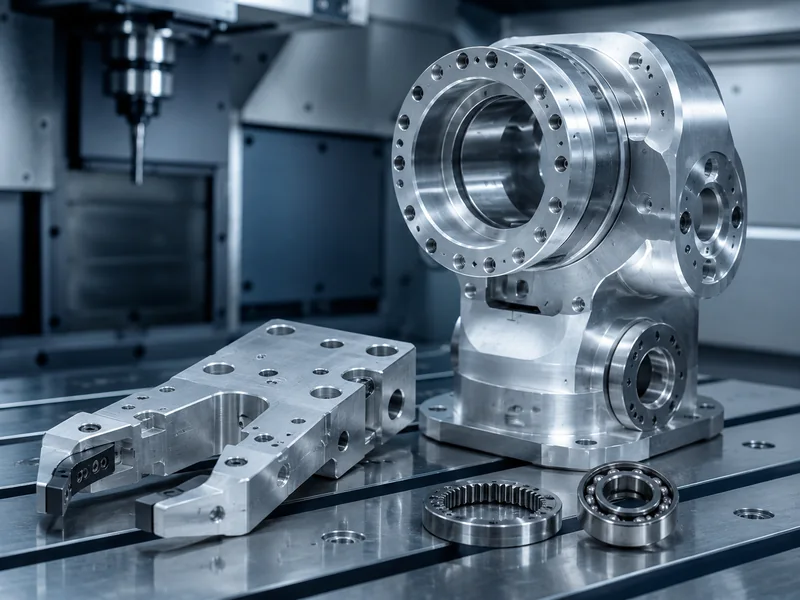
Representative image — customer parts covered by NDA
Customer background
A robotics startup was developing a new collaborative robot arm. Like most hardware startups, they faced a two-phase problem: during development they needed machined prototypes back in days, not weeks, to keep their iteration loop fast — and once the design froze, they needed the same supplier to scale smoothly into production without requalifying parts.
The challenge
The arm's joint assemblies combined thin-walled aluminum housings, bearing seats with tight roundness and position requirements, and cosmetic external surfaces that had to anodize uniformly. The design changed constantly — fifteen revisions over the development phase — so every quote, DFM review, and build had to turn around in days to avoid stalling the engineering team.
Our solution
We ran the program in rapid prototyping mode first: each revision uploaded, DFM feedback returned within 24 hours, and machined parts shipped in five days on average. Our engineers flagged manufacturability issues revision by revision — corner radii, wall thicknesses, tolerance callouts — so that by design freeze the parts were already production-optimized rather than needing a redesign for volume.
At design freeze we transitioned the same part files to production tooling: dedicated fixtures, process capability studies on the bearing seats, and in-house anodizing for consistent cosmetics across lots. Because prototyping and production ran on the same machines under the same quality system, no requalification was needed.
Project specifications
| Material | Aluminum 6061-T6, anodized |
| Process | CNC milling & turning, prototype-to-production |
| Iterations | 15 design revisions during development |
| Prototype turnaround | 5 days average |
| Critical spec | Bearing seat roundness & position, cosmetic anodize |
| Industry | Robotics & automation |
Results
Fifteen design iterations were machined at a five-day average turnaround, keeping the customer's development schedule intact. The transition to production required zero part requalification, and the arm launched on time with WFX as the sole supplier for its machined joint components.
